Outdoors
Cherry tomato
Solanum lycopersicum
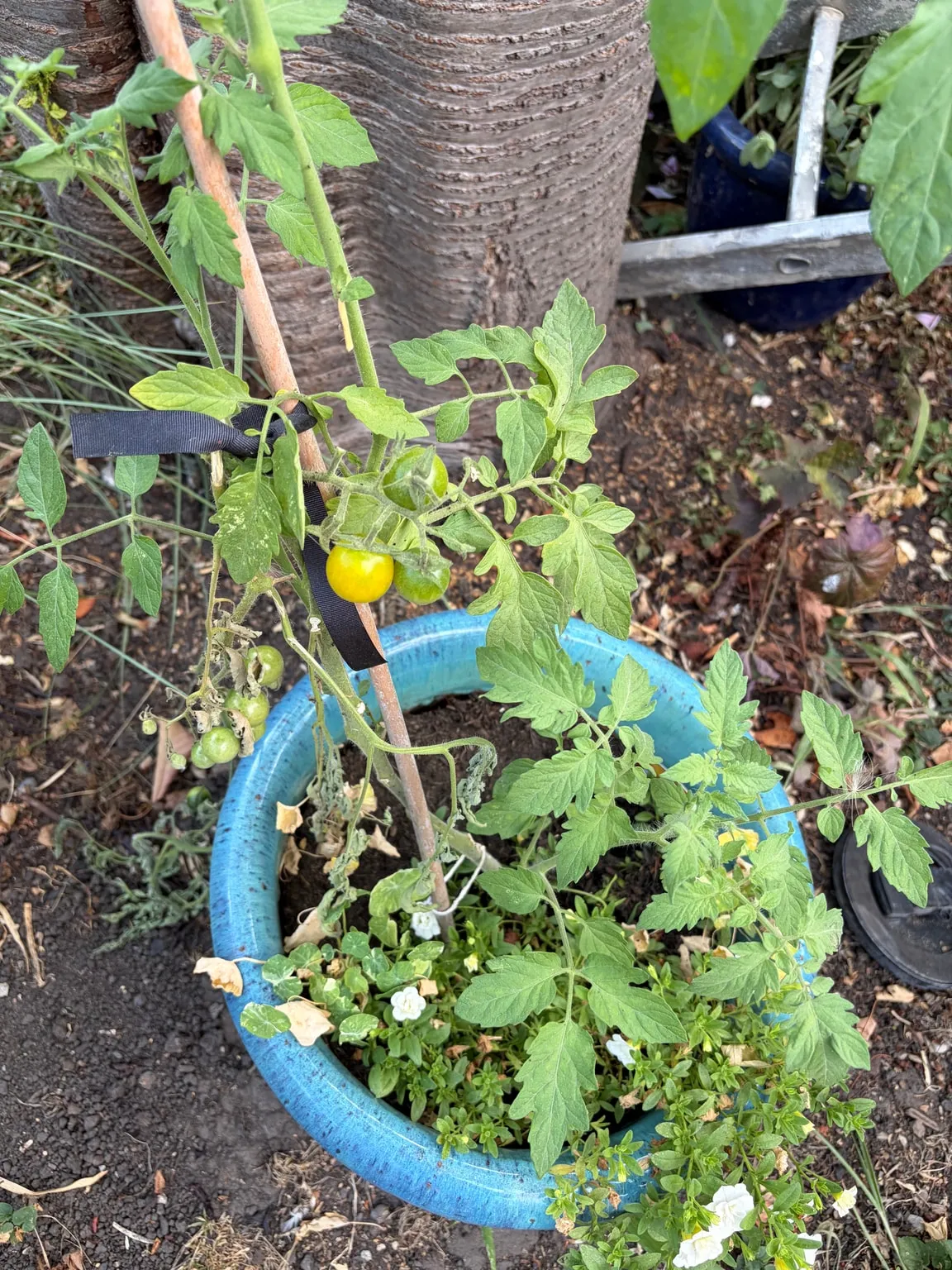
A cherry tomato tied up a cane in the border, carrying trusses of small fruit that ripen unevenly from green through to gold. The thirstiest thing out there.
- In flower now
- Annual
- Thirsty
- Type
- Annual
- Light
- Full sun
- Water
- Thirsty
- Where
- Back garden, tied to a cane in the border
- Flowers
- June–August
- Colour
- yellow
Flowering year
Flowers June–August. It is currently August, so this plant is in flower.
Small yellow star-shaped flowers that are easy to miss; fruit follows each truss by six to eight weeks.
Outlined month is August, today.
Care
- Watering
- Water thoroughly and evenly, every day in hot weather and twice on the worst of them if it is in a pot. Consistency matters more than volume — it is the swing between bone dry and soaking that causes split skins and blossom end rot, not the total amount.
- Feeding
- A balanced liquid feed every ten to fourteen days from planting out, switching to a high-potash tomato feed once the first truss has set fruit, then weekly until it stops. Too much nitrogen late on gives you a large green plant and very little to eat.
- Pruning
- If it is a cordon variety, pinch out the sideshoots that appear in the leaf joints every week and tie the leading stem to the cane as it goes, stopping it after four or five trusses outdoors. If it is a bush variety, leave it alone entirely. Take off the lower leaves once fruit has set below them.
Winter — Nothing to do
It is an annual and the frost ends it, though blight usually gets there first. Pull the whole plant up and bin it rather than composting it, and do not plant tomatoes in the same soil next year.
Pets and children
The fruit is food; the leaves and stems are not. They contain tomatine and will upset a dog or a small child who chews them, so keep the prunings off the ground rather than leaving them where they fall.
Trusses of small round fruit going over from hard green to translucent gold, on a hairy, strong-smelling plant tied up a bamboo cane. Grown as an annual here because it has to be — in its own tropical range it is a sprawling short-lived perennial that would simply carry on.
What it actually wants
Even watering, and it is worth understanding why. Blossom end rot — the sunken, leathery black patch on the underside of a fruit — looks like a disease and gets treated as a calcium deficiency, which is why people buy calcium feeds for it. The soil almost always has plenty of calcium. The problem is transport: calcium moves with water, and a plant whose compost swings between dry and drenched cannot get it into the fruit fast enough while the fruit is swelling. Steady watering is the fix, and it is the only fix. Affected fruit never recovers, but the next truss will be fine.
The other thing worth getting right is whether it is a cordon or a bush. Cordons grow on a single leading stem and want their sideshoots pinched out weekly. Bush varieties flower at the ends of their own sideshoots, so removing them removes the crop. If the label has gone, leave the shoots on and watch — a cordon keeps extending upwards indefinitely, a bush stops itself at about knee height and starts flowering everywhere at once.
Winter
There is no overwintering it. In most years late blight finishes it before the frost gets a chance — dark patches spreading on the leaves and brown, collapsing stems, usually a week or so after a warm wet spell in August. Once it has it the plant is done: take it out, bin it rather than compost it, and pick everything still on it. Green fruit ripens indoors in a paper bag, faster with a banana in there for the ethylene.