Indoors
Rubber plant
Ficus elastica 'Tineke'
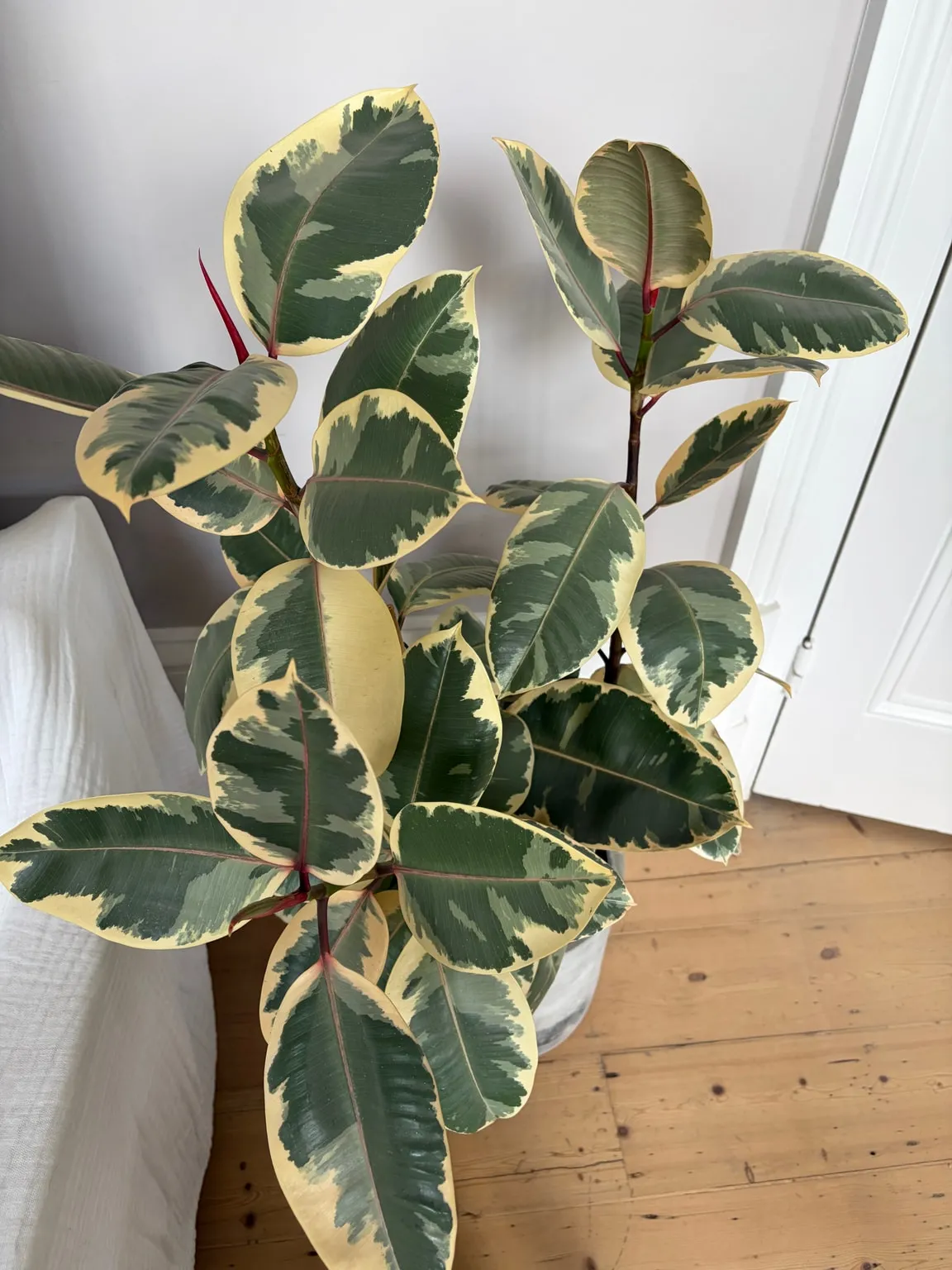
Big leathery oval leaves edged in cream over grey-green, on red-pink stems. Tougher than it looks and far more likely to be killed by attention than neglect.
- Houseplant
- Grown for foliage
- Drought-tolerant
- Type
- Houseplant
- Light
- Bright, indirect light
- Water
- Drought-tolerant
- Hardiness
- H1B
- Where
- Living room, bright spot out of direct sun
Position and soil
- Sun
- Full sun
- Partial shade
- Aspect
- South-facing
- West-facing
- East-facing
- Exposure
- Sheltered
- Soil
- Loam
- Moisture
- Moist but well-drained
- Soil pH
- Acid
- Alkaline
- Neutral
- Ultimate size
- 2.5-4 metres tall × 1-1.5 metres wide · 10-20 years to get there
- Habit
- Bushy
- Foliage
- Evergreen
- Family
- Moraceae
Sourced from the RHS. Figures are the RHS entry for the plain green species; the 'Tineke' page carries no data table, and a variegated plant is slower and smaller than these heights suggest.
Care
- Watering
- Let the top few centimetres dry out completely, then water thoroughly and let it drain properly before it goes back on its saucer. Those thick leaves hold water, so it copes with being forgotten far better than being topped up — overwatering is what kills these, and by the time the lower leaves yellow and drop the roots have usually already gone.
- Feeding
- Balanced liquid houseplant feed once a month through spring and summer. Nothing over winter.
- Pruning
- Pinch or cut out the growing tip once it has the height you want, otherwise it carries on upwards as a single bare stick with a tuft on top. The cut stem bleeds white latex for a minute or two — blot it, keep it off the carpet and off your skin.
Winter — Move away from cold glass
Cold glass and draughts are what make it drop leaves in January, so shift it a foot or two back from the window and away from any door that opens to outside. Keep it off the top of a radiator too, which dries the air and crisps the leaf edges. Much less light means much less water — cold, wet compost is the classic winter houseplant killer. No feeding until spring.
Pets and children
The milky sap is a skin irritant, and mildly toxic if a pet or child chews a leaf — expect a sore mouth and an upset stomach rather than anything worse, but wash your hands after pruning.
A tree, really, doing an extended impression of a houseplant. Big oval leaves, thick and leathery, each one grey-green through the middle with an irregular cream margin and a pink midrib running down it. New growth pushes out of a scarlet sheath at the tip, which unfurls into a leaf and then drops off on its own — that red spike is a good sign, not a problem.
What it actually wants
More light than a plain green one, and no direct sun. Those cream sections have no chlorophyll in them, so the plant is running on perhaps two-thirds of the leaf area it appears to have and needs a brighter spot to make up the difference. Put it somewhere dim and the new leaves come through greener and smaller as it compensates. Put it in direct summer sun and the cream scorches to brown paper, permanently. The bright end of indirect is what it wants, and there is less room for error than the plain form allows.
If a shoot does come through entirely green, take it off at the base. Green growth has the advantage and will gradually take the plant over if it is left.
Move it and it will drop leaves. Bring it home from the shop, shift it to another room, take it to a new house — a week or two later you get two or three of the lower leaves on the floor. This is normal and it is not a request for water or a bigger pot. Put it somewhere sensible, leave it alone, and it settles down.
Dust is the quiet problem. A film of household dust on leaves that size measurably cuts the light reaching them, and unlike a fine-leaved plant it has no way of shedding it. Wipe both sides with a damp cloth every few weeks — it also flushes out the spider mite that likes to set up on the undersides.
It will also lean hard towards the nearest window, and because it grows on one stem the lean becomes permanent rather than something it grows out of. Give the pot a quarter turn whenever you water and it stays upright.
Winter
Light drops off sharply from November and the plant more or less stops. Water it noticeably less — every few weeks, and only once the compost is dry well below the surface. The real risk is the windowsill: cold glass at night, a draught whenever the front door opens, and a radiator underneath doing the opposite. Move it back into the room, stop feeding, and leave it be until March.