Indoors
Palm
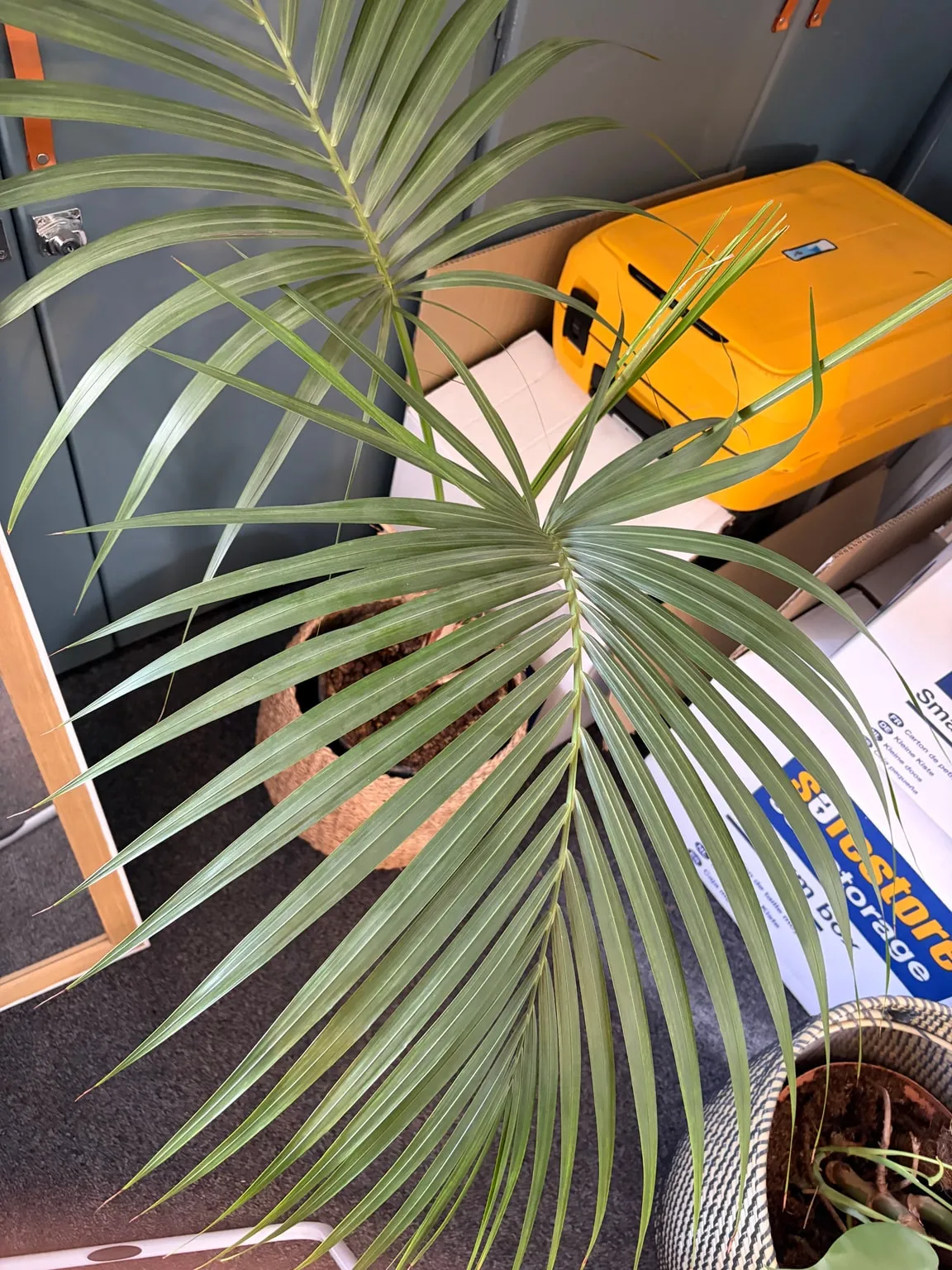
An indoor palm with long arching fronds of fine, narrow, grey-green leaflets. The species is not settled — see the note at the bottom of this entry.
- Houseplant
- Grown for foliage
- Average
- Type
- Houseplant
- Light
- Bright, indirect light
- Water
- Average
Care
- Watering
- Water when the top three or four centimetres are dry, thoroughly, until it runs from the bottom, then empty the saucer. Every indoor palm dies the same way — roots left standing in water — and none of them recover from it, because a palm cannot regrow a rotted stem.
- Feeding
- Balanced liquid houseplant feed at half strength monthly through spring and summer. Nothing from October to March.
- Pruning
- Only remove fronds that have gone fully brown, cutting them off close to the stem. Never cut the top out of a palm — see below. For browned tips, trim just outside the dead part and leave a thin brown margin; cutting back into green tissue kills more of the leaflet behind the cut.
Winter — Water much less
Much less light means much less water — every two or three weeks, and only once the compost is dry well below the surface. Keep it above 10°C, off cold glass and away from radiators, which dry the air and brown the tips faster than anything else in the house. No feeding until spring.
Pets and children
The true palms sold as houseplants are all non-toxic to cats and dogs. Worth knowing that the one dangerous lookalike, sago palm, is not a palm at all but a cycad and is seriously poisonous — it has stiff, dark, needle-like leaflets rather than these soft narrow ones.
Long fronds arching out and over, each one carrying a great many narrow leaflets in a flat plane along a slender midrib. The colour is a soft grey-green rather than a deep one, and the leaflets taper to fine points.
What it actually wants
The single most useful thing to know about any palm is that it grows from one point. Each stem has a single growing tip at its crown, and every new frond comes from there. It cannot branch, it cannot break from lower down, and if that tip is cut off or rots the stem is finished — permanently, however healthy the rest of it looks. So there is no such thing as pruning a palm back to make it bushier, and a palm that is too tall is a palm you live with or replace. All you ever remove is fronds that have already died.
Old fronds yellowing from the bottom is not a fault. The plant is withdrawing what it can from them before letting them go, which is why it is worth waiting until one is properly brown before cutting it off rather than tidying it away while it is still half yellow.
Brown tips are the standard indoor palm complaint and are usually dry air. Central heating in winter is the worst of it. Some palms are also sensitive to the fluoride and chloride in tap water, which accumulates in the compost and burns the tips from the ends inwards — if the air is reasonably humid and the tips still brown, that is the likely cause, and rainwater fixes it.
Winter
Water it much less and otherwise leave it alone. The two things that do real damage are compost that stays cold and wet, and a position between a radiator and a cold pane, which subjects it to both dry heat and night chill. Move it into the room, stop feeding, and accept that it will not put out a new frond until spring.
On the identification
This is filed at genus level on purpose. The frond is clearly that of a true
palm, but the fine narrow leaflets and light colour fit an areca
(Dypsis lutescens) and a kentia (Howea forsteriana) about equally well from
this angle, and a majesty palm (Ravenea rivularis) cannot be ruled out either.
The base settles it: an areca grows as a clump of thin, yellow-orange, bamboo-like
canes; a kentia comes up on one to three plain green stems with broader,
more drooping leaflets; a majesty has a single stout trunk, often swollen at the
bottom. A photograph of the pot and the stems will move this entry to
confirmed. Until then the advice above is deliberately limited to what holds
true for all of them.