Indoors
Christmas cactus
Schlumbergera truncata
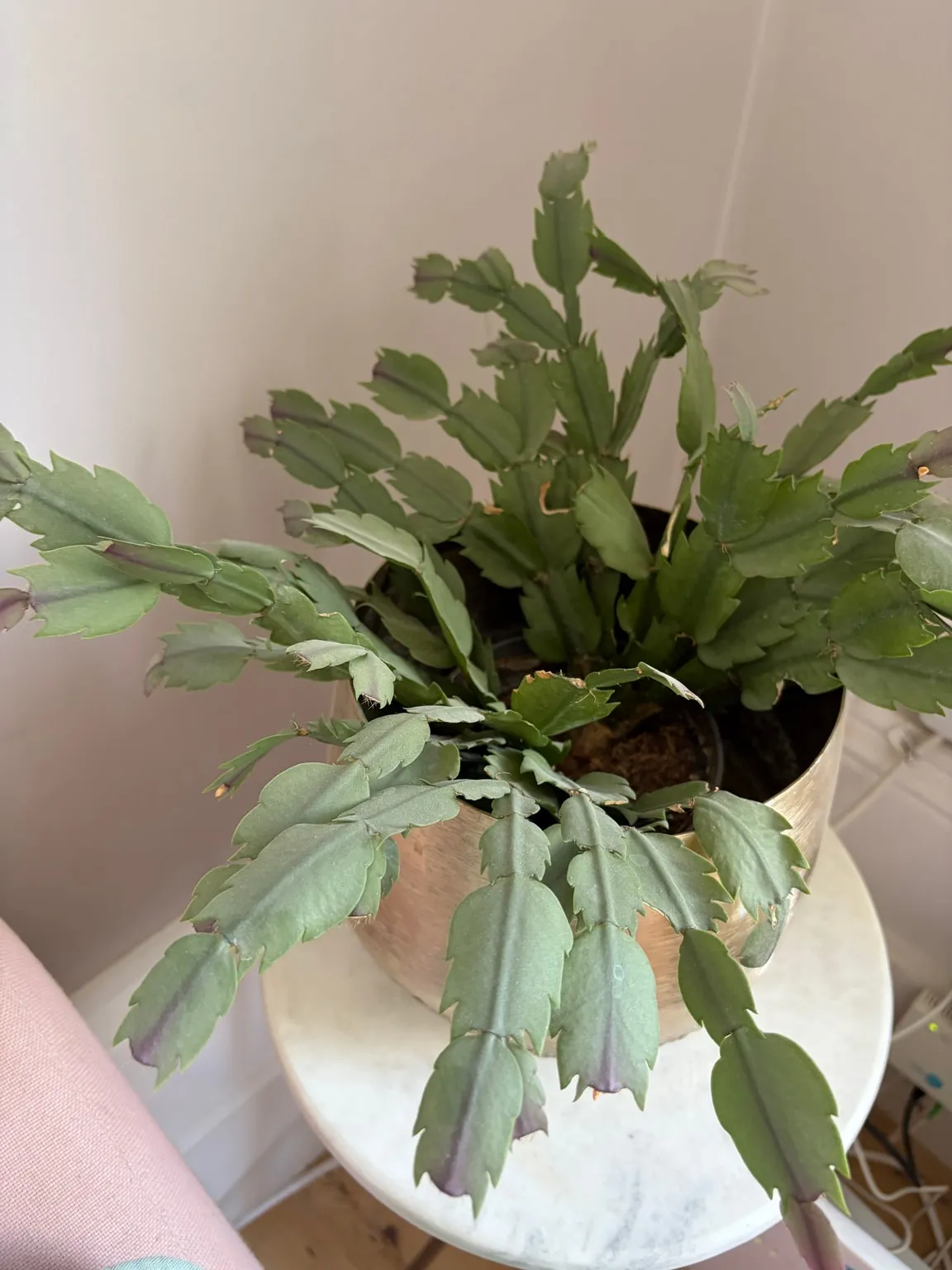
Flattened, sharply toothed stem segments arching out and hanging over the pot. A Brazilian forest epiphyte rather than a desert cactus, and it wants the opposite of what that name suggests.
- Houseplant
- Average
- Type
- Houseplant
- Light
- Bright, indirect light
- Water
- Average
- Where
- Living room, side table back from the window
- Flowers
- November–January
Flowering year
Flowers November–January. It is currently August, so this plant is not in flower.
The pointed-toothed species is the early one — buds usually open from November and are often finished by Christmas.
Outlined month is August, today.
Care
- Watering
- Water when the top couple of centimetres have dried, then let it drain properly. It holds water in the segments but nothing like as much as a desert cactus, and a plant kept bone dry for months goes limp and wrinkled rather than sitting there patiently. Standing water at the base is still what kills it.
- Feeding
- Half-strength balanced liquid feed once a month from spring until late summer, then stop. Feeding into the autumn keeps it growing when it should be setting buds.
- Pruning
- After flowering, twist two or three segments off the end of any stem that has got long and bare. It branches from the cut and flowers on the new tips, so this is what keeps an old plant full rather than straggly. The pieces you removed root in compost in a few weeks.
Winter — Move away from cold glass
It flowers over the winter rather than sleeping through it, so this is the season it needs paying attention. Keep it cool and out of draughts from doors and cold glass, and well away from a radiator, which will shorten the flowering by weeks. Once buds have formed, stop moving it.
Pets and children
Non-toxic to cats and dogs, which makes it one of the few houseplants here that does not need putting out of reach.
Flattened, segmented stems that grow upright at first and then arch over and hang down the sides of the pot, each segment about the length of a thumb with sharp forward-pointing teeth along its edges. It is a cactus, but a forest one — it grows in leaf litter caught in the forks of trees in coastal Brazil, in shade and humidity, which is roughly the opposite of what most people picture.
What it actually wants
The teeth tell you what you have. Sharply pointed, claw-like segments mean Schlumbergera truncata, the crab cactus, which flowers from about November. Rounded, scalloped segments mean S. × buckleyi, the true Christmas cactus, which flowers several weeks later. Almost everything sold under the Christmas name is the first one, which is why so many of them are over before December is out. This one has the pointed teeth.
Buds are set in autumn and nothing you do in December will produce them. It needs several weeks of long, unbroken nights and cool temperatures — somewhere around 12 to 15°C — to start the process. A plant in a room where a lamp goes on every evening will grow perfectly happily and never flower, and that is a far more common cause than any question of feeding or pot size.
Once buds have formed, leave it where it is. Turning the pot round, carrying it into another room, or a draught from a door opening is enough to make it drop every one, and it does not make a second set.
The purple flush along the segment edges is a light response, not a symptom. It is getting slightly more sun than it needs, and moving it back from the window will bring the green back.
Winter
This is its season, so it does not get the reduced-watering treatment the other houseplants get. Keep watering while it is in bud and flower, lightly, letting the surface dry between times. Cool is better than warm — a hallway suits it better than a spot above a radiator, which will bring the flowers on fast and finish them just as quickly. When it has finished, give it about six weeks cooler and drier before feeding starts again in spring.