Indoors
Chinese money plant
Pilea peperomioides
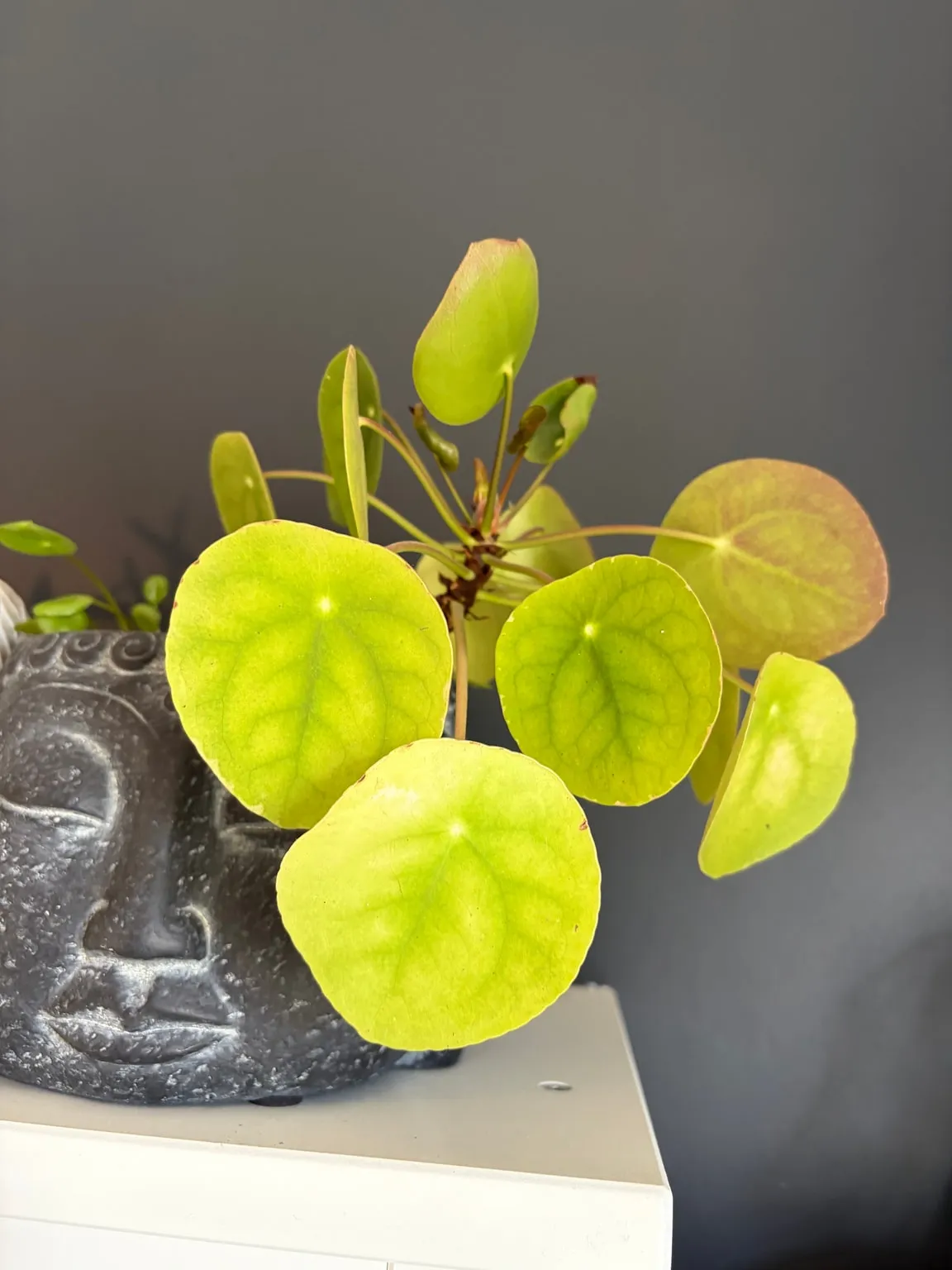
Flat round leaves like coins held out on long stalks from a short central stem. Currently paler than it should be, which is a light problem rather than an illness.
- Houseplant
- Grown for foliage
- Average
- Type
- Houseplant
- Light
- Bright, indirect light
- Water
- Average
- Where
- Shelf by the window
Care
- Watering
- Water when the top two centimetres have dried, thoroughly, and tip away anything left in the saucer. The leaves are fleshy enough to hold a reserve, so it droops theatrically when thirsty and recovers within an hour or two — the roots are far less tolerant of sitting wet, and rot at the base is what actually kills them.
- Feeding
- Half-strength balanced houseplant feed monthly from spring to late summer. Pale leaves in good light usually mean it is hungry rather than ill.
- Pruning
- Nothing to prune. Take off the lowest leaves as they yellow and go — the stem is meant to go bare and woody at the base with age, and a tall bare stem with a head of leaves is what an old one looks like, not a failure.
Winter — Water much less
Water perhaps every two or three weeks through the winter, and only when the compost is properly dry. Keep it above 10°C and off cold windowsills, but it does not need coddling — cold wet compost is the only real risk. No feeding until spring.
Pets and children
Non-toxic to cats, dogs and children, which along with the offsets is most of why it gets passed around.
Flat, almost circular leaves on long stalks radiating out from a short upright stem. The stalk joins each leaf in the middle of its underside rather than at the edge — the little pale dot in the centre of every disc is where it attaches — and that is what gives it the shape nothing else quite has.
What it actually wants
Bright light, but not the sun itself. The leaves in this one have gone yellow-green rather than mid-green, and the uppermost ones have a bronze flush across the top, which together is a sunburn response rather than a disease. It is sitting somewhere too bright and too direct. Moved back from the glass it will green up over the following few months, though the bleached leaves themselves stay bleached — new growth is what recovers, not old.
If it is pale in light that is genuinely indirect, the answer is the opposite: it is hungry. They are greedier than their size suggests and a monthly feed through summer makes a visible difference.
The whole plant turns to face the light, and because the leaves are discs on stalks it does this more obviously than anything else in the house — within a few weeks every leaf is pointing the same way and the stem has started to lean after them. A quarter turn each time you water is enough to keep it even.
Offsets come up around the base from the roots, and sometimes straight out of the stem. Let them reach about 5cm, cut them off below soil level with a bit of root attached, and pot them up. This is the entire reason the plant spread around the world before it was ever sold commercially.
Winter
Very little to do. Water it far less and let it sit. It will hold its leaves through the dark months without complaint provided the compost is not staying wet, and the first thing it does in spring is throw up a crop of new offsets.