Indoors
Anthurium
Anthurium andraeanum
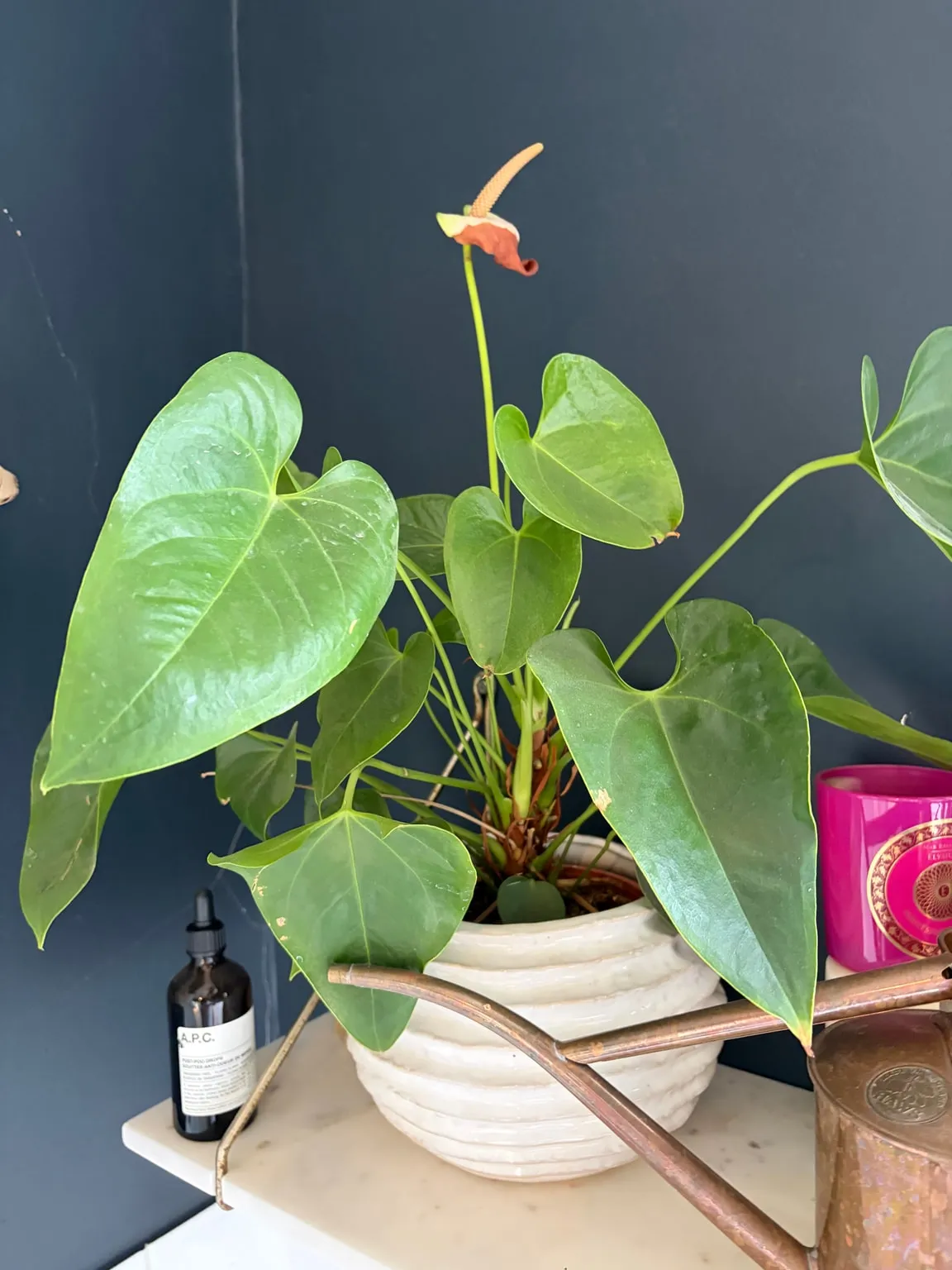
Glossy dark heart-shaped leaves on long stalks, with a coral-orange spathe and a pale curved spike held above them. Flowers on and off all year rather than in a season.
- In flower now
- Houseplant
- Average
- Type
- Houseplant
- Light
- Bright, indirect light
- Water
- Average
- Where
- Marble shelf, bright indirect light
- Flowers
- January–December
- Colour
- orange, coral
Flowering year
Flowers January–December. It is currently August, so this plant is in flower.
Not seasonal indoors — it flowers in flushes whenever it is warm and bright enough, and each spathe lasts six to eight weeks.
Outlined month is August, today.
Care
- Watering
- Water when the top few centimetres are dry, thoroughly, and let it drain right through. It wants to be evenly moist rather than either extreme, and because it is an epiphyte the roots need air as much as water — a pot that stays saturated will rot the crown from the middle outwards.
- Feeding
- Orchid fertiliser every fortnight from spring to autumn. Nothing over winter.
- Pruning
- Cut spent flower stems right down at the base once the spathe has faded, and take off yellowing lower leaves the same way. Do not cut the aerial roots off — see below.
Winter — Water much less
Water sparingly through the winter and stop feeding altogether. The thing it genuinely will not tolerate is cold — it wants to stay above about 18°C, which is warmer than most rooms get overnight, so keep it well away from cold glass and external doors. A cold, wet winter is what turns the crown to mush.
Pets and children
All parts contain calcium oxalate crystals and the sap is a skin and eye irritant. A chewed leaf will burn a pet or child's mouth, and it is worth washing your hands after cutting anything off it.
Thick, glossy, deeply notched leaves on long stalks coming out of a central crown, and above them a single coral-orange flower on a slender stem. Everything about it is built for a warm, wet forest, which is worth keeping in mind because almost every way of killing one comes from treating it as an ordinary pot plant.
What it actually wants
The flower is not a flower. The coloured part is a spathe — a modified leaf — and the pale curved spike coming out of it is the spadix, which carries dozens of tiny real flowers. That is why it lasts six or eight weeks instead of a few days, and it is also why an ageing spathe turns green rather than dropping: it is reverting to being a leaf. A green anthurium flower is an old one, not a sick plant, and cutting it off is a matter of taste.
The compost matters more here than for anything else in the house. It grows on tree trunks, not in soil, and in ordinary houseplant compost the roots suffocate as the mix settles and packs down over a year or two. It wants something coarse and open — a peat-free base cut heavily with perlite and orchid bark — and repotting into that is usually what fixes a plant that has quietly stopped flowering.
Those pale roots pushing out of the compost at the base are aerial roots doing exactly what they would do on a tree, and the plant slowly walks itself upwards out of its own pot as it makes more of them. Do not trim them. Top the pot up with more bark mix so they have something to grow into.
Winter
The hard limit is temperature, not light. Below about 18°C it stops, and a cold night against a window will do visible damage. Move it into the room, cut the watering right back, stop feeding, and expect no new flowers until spring — the leaves it has will hold perfectly well in the meantime.